
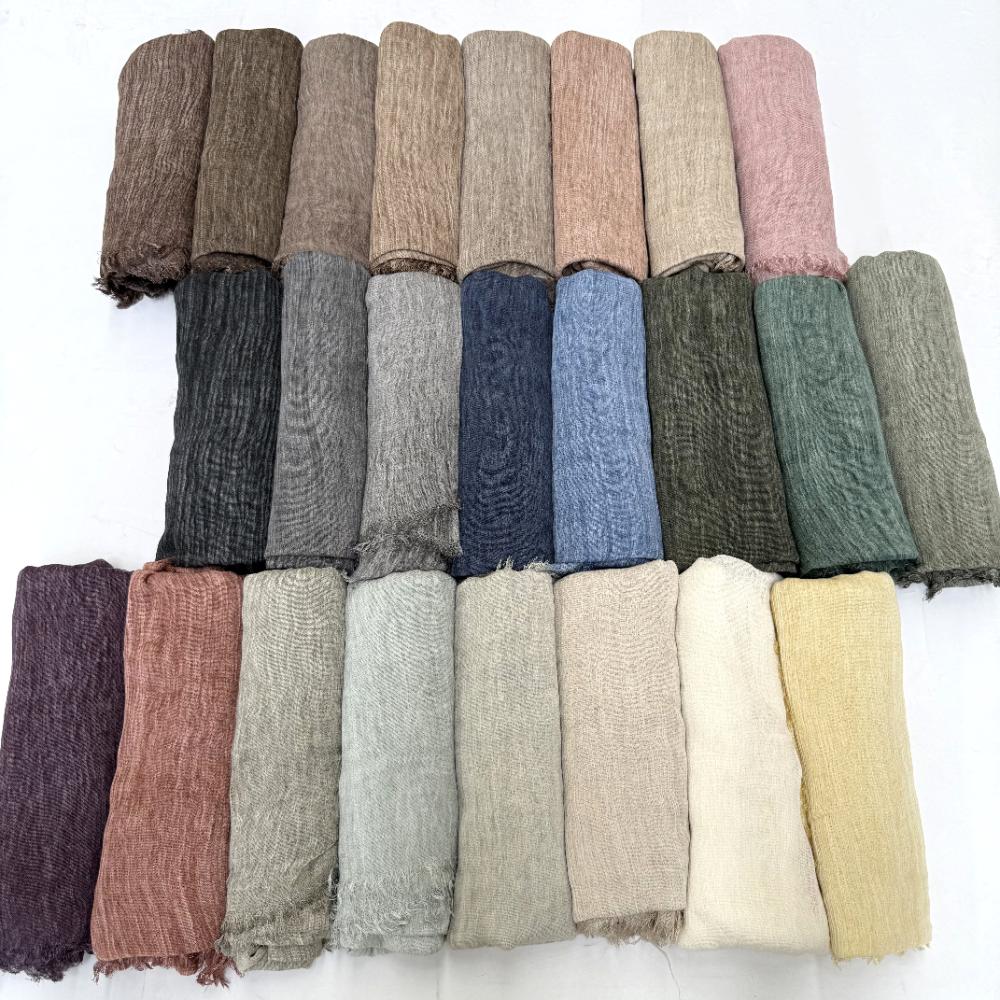
Scarf Weight RFQs: Define the Unpacked Piece
P193 catalogue assortment. Its folded presentation identifies the product reference, while the page separately lists a 110g weight entry.
For a scarf weight RFQ, ask whether the listed grams describe one complete unpacked scarf, and identify anything included in that value. Wenyu lists P193 at 110g, plain BL-232 at 80g and hot-fix rhinestone BL-232 at 105g. Keep each figure attached to its own product version. Request confirmation of the weight basis before using those entries in a purchasing comparison.
Buyers comparing wholesale solid dirty-dye scarfs with other scarf constructions need a consistent unit of comparison. A scarf’s catalogue weight, its packaged sales weight and fabric mass per unit area answer different questions. A short weight record helps the supplier explain what was listed and lets the purchasing team compare the offered items on an agreed basis.
Copy the product-specific figures first
The Modal Dirty-Dye P193 page lists a size of 70cm × 190cm and a weight of 110g. The plain BL-232 page lists 90cm × 180cm and 80g. Its separate hot-fix rhinestone version lists 90cm × 180cm and 105g. These are catalogue entries, rather than measurements made for this guide.
Retain the full product link and version name beside each weight. The two BL-232 listings share a code, so the code alone is insufficient for this record. Record the selected colour or sample reference as well. If the supplier offers a changed size or construction, request a corresponding weight response for that option instead of carrying forward the original page figure automatically.
Reference
Listed size
Listed weight
Basis to confirm
P193 Modal Dirty-Dye
70cm × 190cm
110g
One finished piece and included components
BL-232 plain
90cm × 180cm
80g
Same defined unit for the offered version
BL-232 hot-fix
90cm × 180cm
105g
Finished decorated article versus another basis
Define the item placed on the scale
Ask the supplier whether its stated value applies to one complete scarf, a fabric-only reference or another defined item. For an unpacked-piece comparison, specify the scarf as offered and clarify the treatment of attached labels, removable tags and any decorative components. Record these decisions beside the value. This gives the supplier a direct question without assuming how the catalogue number was produced.
Name the exact scarf version and selected sample reference.
State the number of pieces represented by the returned weight.
Identify included article components and excluded packaging.
Ask whether the answer is nominal or measured on an identified sample.
Keep bag, sleeve, box and other sales packaging in a separate field if those items form part of the proposed presentation. A packaged weight can be useful for a different purchasing task, but it should be clearly named. The buyer should not have to infer whether two supplier values describe the same physical unit before comparing them.
Plain BL-232 catalogue reference. Its 80g page entry remains separate from the hot-fix version and from any packaging weight.
Record a sample response without inventing a tolerance
When a sample is available, ask the supplier to identify the piece used and document the agreed weighing condition. Keep the returned result beside the nominal catalogue entry rather than replacing it. If the buyer needs a proposed acceptable range, request it for that particular style and review it explicitly. The pages cited here do not establish a universal weight tolerance.
Do not treat 80g, 105g or 110g as fabric grams per square metre. The pages label the field as weight in grams. They do not provide a GSM value or the definitions needed to turn a finished-article number into one. Similarly, subtracting the two BL-232 figures does not independently establish the weight of their rhinestones or any other component.
A useful response identifies the same product, the counted unit, the included components and the nominal or sample-measured basis. Purchasing can then decide whether the information meets the intended requirement. A measured sample result remains linked to that sample and condition; it is not automatically a guarantee for every future piece or a shipping-charge calculation.
Send one clear weight clarification
An enquiry can read: “For P193, please confirm what your listed 110g represents. We need the weight basis for one complete unpacked scarf of the offered version. Identify included labels or decoration, exclude sales packaging in this field, and state whether the answer is nominal or measured on an identified sample. Please propose any applicable range separately.”
Repeat the same fields for any BL-232 option included in the comparison. Send the product references and requested weight basis through the Wenyu contact page. This produces a practical answer for the selected scarf without confusing article weight, fabric-area weight and packed presentation.
Separate hot-fix BL-232 version. Its 105g listing does not isolate a decoration weight or define a packed retail unit.
Frequently asked purchasing questions
Is P193’s 110g a confirmed unpacked-piece weight?
It is the page’s weight entry. Ask the supplier to confirm the represented item, included components and offered version.
Can the listed grams be called GSM?
The source lists grams, not grams per square metre. Keep the field as stated and request fabric-area weight separately if required.
Does the 25g difference measure the rhinestones?
No component measurement is provided by those two catalogue entries. Request a component-specific answer if that detail is needed.
Should packaging be included in the comparison?
Use a separate, clearly named packaged-weight field. Compare unpacked pieces only after their article scope is aligned.
Scarf WeightUnpacked PieceBuyer RFQ