
P-193 Scarf RFQs: Check Both Quantity Minimums
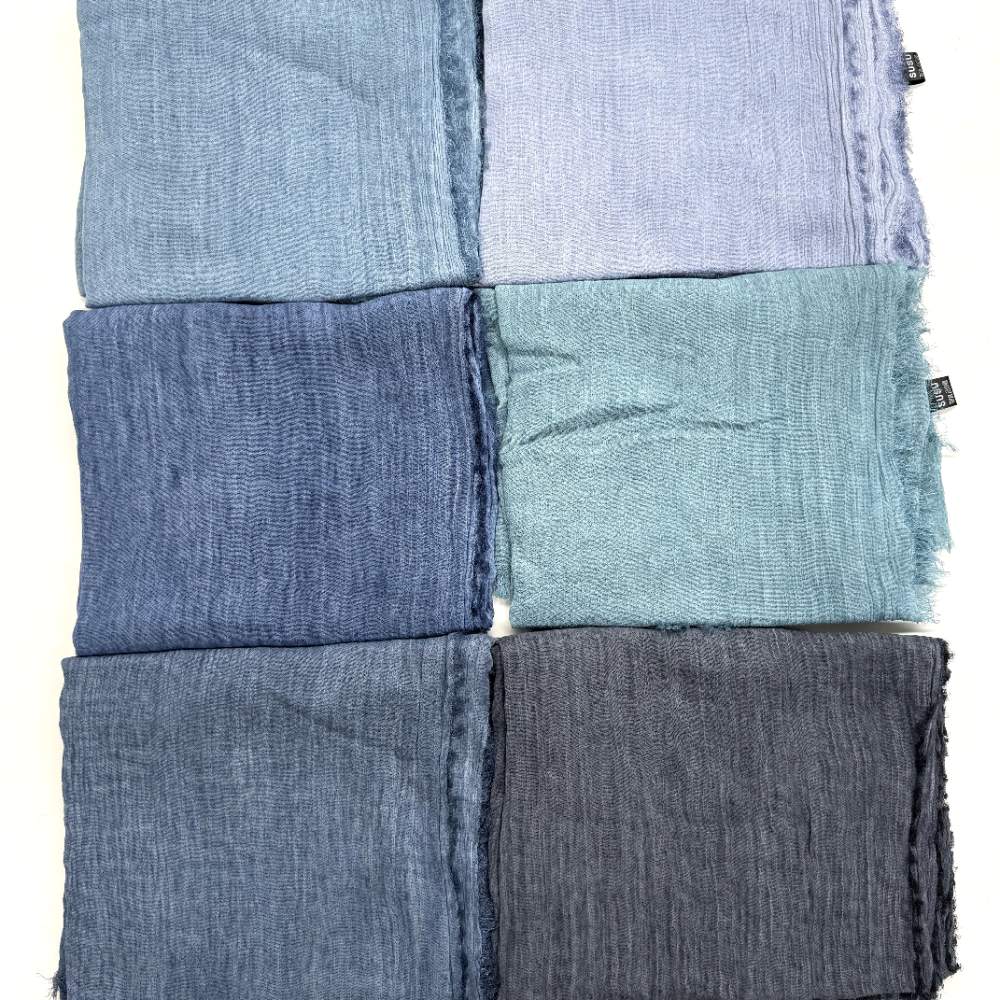
P-193 product appearance reference. The pictured colours and small visible labels do not establish availability, an offered assortment or current order terms.
Check both quantity conditions when preparing a P-193 scarf RFQ. Wenyu’s Modal Dirty-Dye P-193 page states 50 pieces per colour, with a total minimum of 600 pieces. A plan can reach 600 overall while falling below the per-colour figure, or satisfy each colour row while missing the total. Use both catalogue conditions as a planning starting point and request confirmation for the current enquiry.
For a buyer sourcing wholesale solid dirty-dye scarfs, the useful record is a colour-by-colour quantity schedule. The catalogue display can help select candidates, but it does not provide an agreed colour allocation. The calculations below show how to check a proposed schedule; they are hypothetical arithmetic examples, not offers of particular colours, stock or commercial conditions.
Attach the quantity schedule to the actual article
The Modal Dirty-Dye P-193 listing identifies Material: Modal, Size: 70cm × 190cm and Weight: 110g. Retain the product URL and P-193 reference above the quantity table. These catalogue fields distinguish the enquiry from another dirty-dye scarf with its own conditions.
Ask the supplier to identify the offered colour references and confirm which quantity conditions apply to the selected version. Keep a custom-colour or changed-size request visible as a separate specification question. Do not assume that an earlier response for another article supplies the terms for P-193, or that several different scarf styles can be pooled into its total.
Give each minimum its own check
The per-colour check asks whether every requested colour row reaches the stated starting quantity. The total check asks whether all requested P-193 pieces add up to the overall starting quantity. Record the two results separately. Passing one does not answer the other, even when the overall order sounds large.
For each proposed colour, record the supplier reference, buyer quantity and any open question. Add the quantities to obtain the article total, then review every individual row. Keep a row below the starting figure clearly flagged instead of burying it inside a total that otherwise reaches 600.
Hypothetical plan
Total pieces
Arithmetic check against listed starting points
12 colours × 50 pieces
600
Meets both quantity figures mathematically
6 colours × 100 pieces
600
Meets both quantity figures mathematically
8 colours × 50 pieces
400
Per-colour figure met; total below 600
15 colours × 40 pieces
600
Total reached; each colour below 50
The first two plans use different colour spreads but the same total. This illustrates why the supplier needs the breakdown as well as the headline number. It does not establish that six, twelve or fifteen requested colour references are available or can be combined under the current offer.
Catalogue colour candidates for P-193. A display of many scarves does not define the number of colours accepted in a quotation.
Keep requested quantities distinct from alternatives
If the initial plan falls short of a listed condition, ask the supplier to respond to that exact plan. It may answer the enquiry or propose a different arrangement. Keep any proposal on a separate line showing which original request it addresses, so the buyer can see the effect on colour spread and total pieces.
Do not silently add an unwanted colour, increase a row or substitute another scarf to make a spreadsheet check pass. The quantities describe a buying requirement, not just a mathematical exercise. Record the buyer’s accepted revision explicitly before treating a proposed change as the new order schedule.
Original requested P-193 colour and quantity.
Per-colour and overall checks shown separately.
Supplier response to the original plan.
Proposed alternative and its revised total.
Buyer decision on the specific change.
Request current conditions against the same schedule
Send the dated schedule with the product URL and ask the supplier to confirm the current per-colour and total conditions for that enquiry. Request clarification about whether the response covers the exact selected colour references and product version. Keep those commercial answers beside the relevant schedule revision.
A concise request can say: “For the attached P-193 colour quantities, please confirm the applicable per-colour minimum and article total, identify unavailable references, and show any alternative separately. Please state the commercial conditions for this exact proposed assortment.” This asks for a usable response without presenting a catalogue field as an accepted order.
Separate P-193 assortment view. Colour identity and quantities still need the line-level supplier response; appearance approval is a different task.
Carry the accepted breakdown into the order
Once the supplier has answered, reconcile every accepted colour row with the final article total. Keep unresolved references outside the confirmed quantity rather than presenting a partial response as the complete intended assortment. Ask the supplier to acknowledge the same breakdown used by purchasing.
Retain that schedule with the quotation and sample references. A later colour replacement or quantity change should produce a revised total and a fresh check of both conditions. Keep shade-range approval, material questions and packing information as separate records so a correct quantity calculation does not imply those decisions are complete.
Frequently asked questions
Does a 600-piece total satisfy both catalogue conditions?
Check every colour row as well. A hypothetical plan of fifteen colours at forty pieces reaches 600 but remains below the listed fifty-piece per-colour starting figure.
Can fewer colours make up the total?
The arithmetic can work, as the hypothetical six-colour example shows. Ask the supplier whether the selected colour quantities and current conditions are accepted for the actual enquiry.
Can another scarf’s quantity count toward P-193?
Do not assume that aggregation. Keep each article identified and ask the supplier to confirm any proposed combined-order arrangement explicitly.
Where should the completed plan be sent?
Use the Wenyu contact page with the P-193 URL, colour references and quantity table, requesting confirmation against its dated revision.
Scarf SourcingOrder QuantitiesRFQ PreparationWholesale Purchasing