
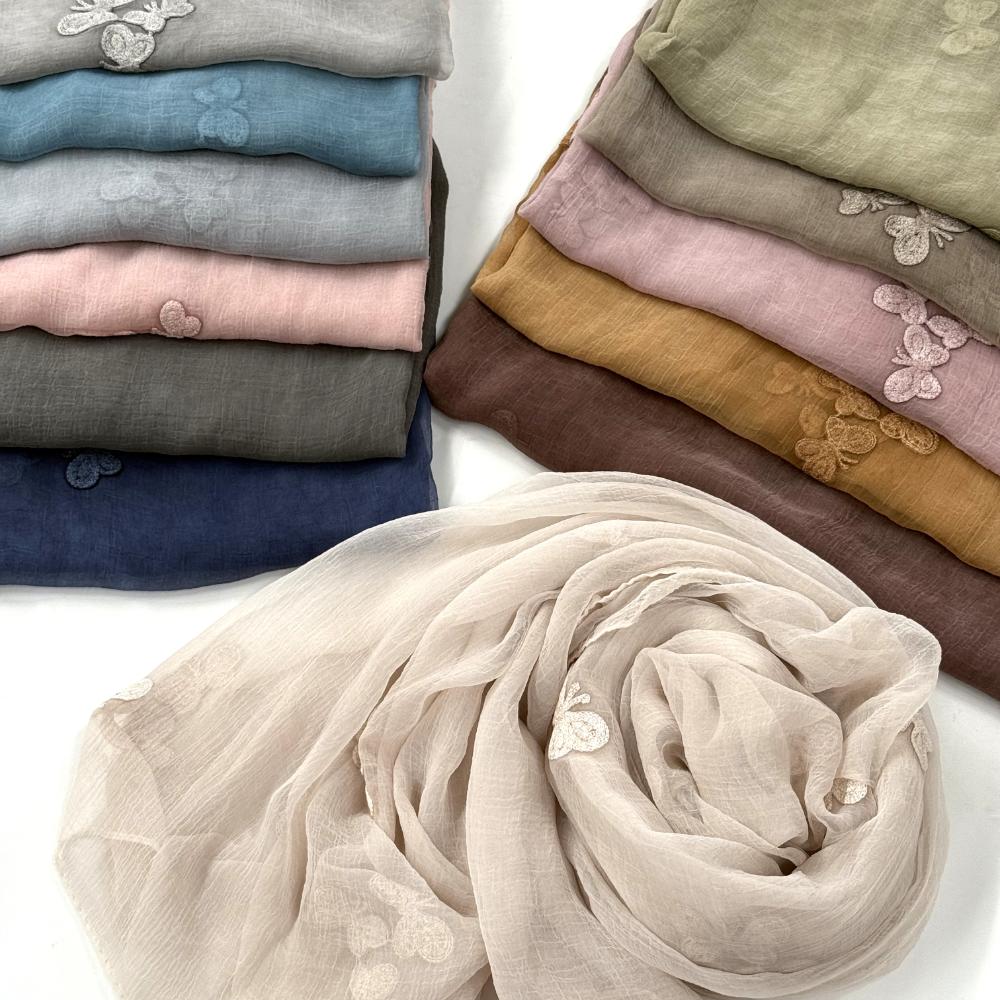
K-846 Scarf RFQs: Request the Care File
What should a care-file enquiry for the K-846 embroidered scarf contain? Identify the offered K-846 version, request the manufacturer information applicable to the complete scarf, and ask how that information covers its base fabric and embroidery. Request the actual document identifier and language version. Link the response to the sample and quotation rather than borrowing instructions from another crinkle scarf.
K-846 catalogue reference. Visible embroidered details and folds do not establish fibre composition, care instructions or cleaning performance.
Start with the K-846 catalogue identity
Wenyu presents K-846 as a Crocodile Crinkle Embroidered Scarf. The archived product page describes a crinkled fabric with embroidery. That combination gives the supplier a concrete starting point for the care-information enquiry. The category wording helps identify the item, but it does not identify a verified fibre composition or provide a finished-scarf washing instruction.
For a wholesale crocodile crinkle embroidery enquiry, attach the K-846 product link and identify the actual version under discussion. If the supplier offers a revised base fabric or embroidery specification, ask whether its response still represents the catalogue version. Record the offered variant before comparing documents so that an answer about another scarf does not enter this purchase record.
Ask which parts the manufacturer information covers
The finished scarf combines a base fabric with embroidered decoration. Ask whether the supplied care reference applies to the complete article or describes a particular component. A statement about an undecorated fabric does not, by itself, establish the instruction for an embroidered scarf. Request the supplier explanation for any component-specific reference included with its proposal.
Keep that question focused on document applicability. The buyer does not need to invent separate care steps for the embroidery or decide how the surface should respond to cleaning. Where the supplier has not supplied complete-item information, leave that gap visible and ask what reference it proposes for the exact offered K-846.
Buying field
Requested supplier response
Product identity
K-846, the offered variant and a supplier or sample reference.
Finished-item scope
Whether the information applies to the complete embroidered scarf.
Component references
Any separate base-fabric or embroidery information and its stated limits.
Document identity
The file name, revision and issue reference supplied by the manufacturer.
Language scope
Each proposed wording version and the reference it represents.
Sample connection
The item or sample to which the supplied document is linked.
Quotation connection
The proposal identifying any included label or information format.
Open questions
Unexplained differences awaiting a named supplier response.
Separate care information from a label proposal
A manufacturer care document and a label artwork file can serve different purposes. Ask what information the supplier provides for the finished scarf, then ask whether a label, insert or other format is included in the actual offer. A catalogue photograph of an unlabelled fold neither confirms nor excludes a proposed label arrangement.
If artwork is offered, request its actual text and file identity. Compare it with the manufacturer reference and ask the supplier to explain differences. Approval of the visual layout should have its own decision record; it should not be treated as an unexplained confirmation that the wording applies to every K-846 variant.
Separate BL-135 product reference. Its material description and any care document cannot be transferred to K-846.
Keep BL-135 and BL-232 documents separate
The accompanying plain BL-135 scarf is a separate catalogue reference. It illustrates a useful purchasing distinction: a supplier can offer several scarves while using different product descriptions and document scopes. Its folded appearance does not establish that a care file for that style also covers the embroidered K-846.
BL-232 is another separate decorated scarf reference. Decoration alone does not make its care information transferable. If the supplier proposes one document for multiple items, request an applicability list naming those items and any exceptions. Until that scope is confirmed, retain K-846, BL-135 and BL-232 as distinct references in the document register.
Compare the returned file with the identified sample
When the supplier sends a sample and a care reference, retain the connection between them. Record the sample identifier and the file cited in the accompanying reply. If a label is attached, a readable photograph can preserve the wording seen on that sample. Keep the supplied document available alongside that observation.
Where the sample wording and the file differ, ask which version the supplier proposes for the order and why. Preserve both versions while the question is open. Do not repair the difference by copying a washing temperature, drying method or symbol from another scarf; the manufacturer response should clarify the intended instruction and its applicability.
Separate BL-232 decorated scarf reference. Its surface decoration and documents do not define the care scope for K-846 embroidery.
Maintain a clear language and revision record
Give each language file a recognisable identity and keep its revision visible. Ask the supplier which manufacturer reference each version represents. If a translation is proposed, record who is responsible for confirming its intended meaning. A translated sales description does not automatically become an agreed care instruction for the finished scarf.
Retain the supplier response when a file is replaced. Identify whether the change affects the wording, its product scope or only its layout. This makes it easier for the buyer reviewing a later proof to locate the accepted reference without reconstructing the decision from several disconnected attachments.
Carry the accepted scope into the quotation
Before accepting the final proposal, connect the agreed care-reference revision to the offered K-846 and the identified sample. Ask the quotation to describe any included label or document arrangement. If that supply detail is unresolved, record it as a question rather than assuming that a particular component will be provided.
When the offered scarf changes, ask whether the existing reference still applies. Keep the previous file as history and identify the currently proposed revision. An accurate order record can show a confirmed document scope and a remaining question at the same time; it does not need to present an unanswered request as a supplier commitment.
Identify the offered K-846 and sample.
Request complete-item care information and explain any component limits.
Track the actual file, language and revision.
Retain the accepted scope with the quotation.
Buyer FAQ
Does Crocodile Crinkle identify a verified fibre composition?
It is the catalogue material label here. Request the supplier declaration for the offered item instead of treating the label as a fibre analysis.
Can a base-fabric document define care for the embroidered scarf?
Ask the manufacturer to identify whether that document covers the complete K-846 or only a component.
Is a care label included in every enquiry?
The actual proposal needs to define any label or document supply. Request that detail rather than assuming inclusion.
Can BL-232 wording be copied into the K-846 file?
Keep the products separate unless the supplier identifies a shared document applicability scope.
What if a returned sample and its file differ?
Preserve both references, ask which version is proposed for the order, and retain the supplier clarification.
Use the K-846 scarf product reference to identify your care-file enquiry. Explore the scarf purchasing blog for related supplier specification questions.
wholesale crocodile crinkle embroideryB2B supplier sample record